Style Guide · July 2026 · 7 min read
Minimalist Living Room Ideas That Look Curated, Not Empty
The failure mode of minimalist living rooms is that they look empty rather than intentional — bare walls, isolated furniture, rooms that feel like they're waiting for something. The success mode looks effortless: a few precisely chosen objects in exactly the right positions, each one earning its place. Here is how to achieve the latter.
The furniture hierarchy
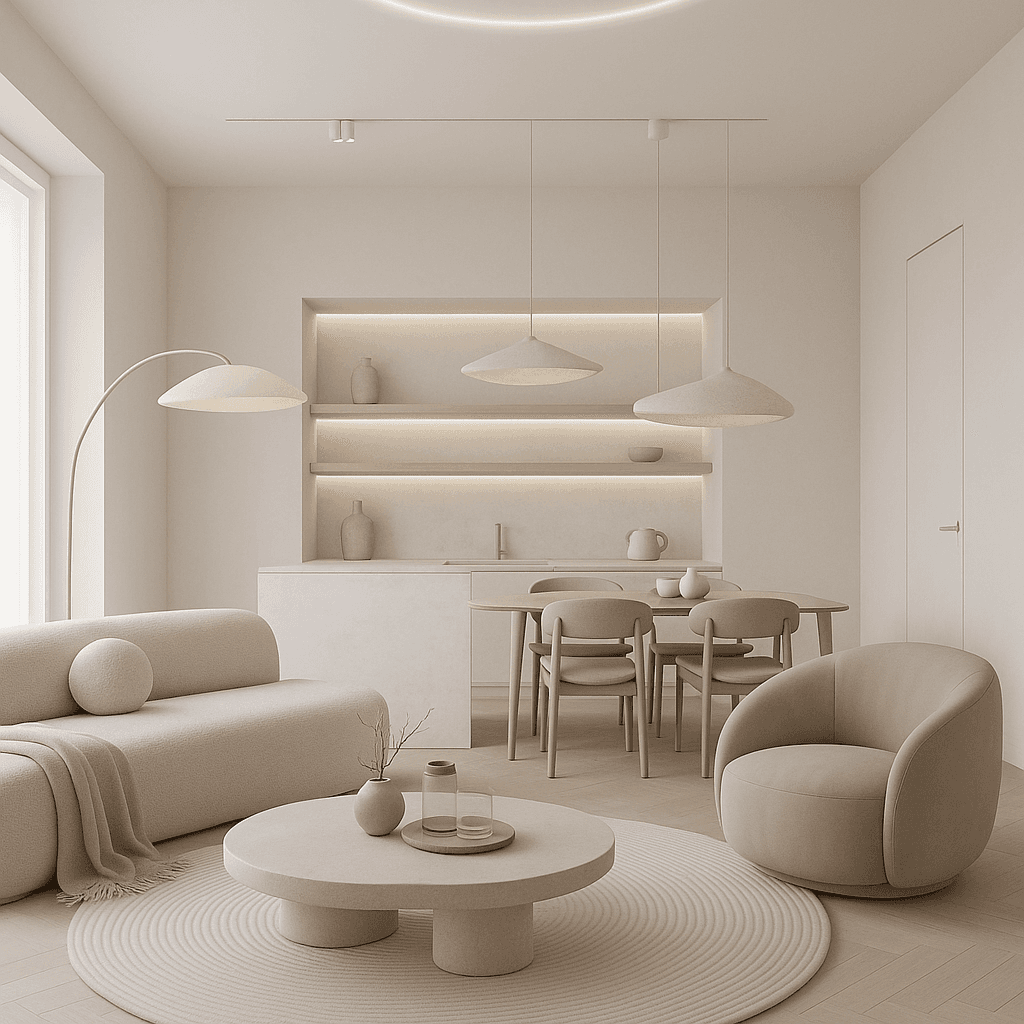
A minimalist living room requires a clear furniture hierarchy. The sofa is the anchor — everything else serves it. Choose one sofa in a quality neutral fabric (linen, boucle, or wool in warm white, stone, or oat) and position it first. Everything else responds to where the sofa sits.
The coffee table is second. In a minimalist room, it should be interesting enough to carry the room when the sofa is plain. Stone, travertine, or dark-stained oak all read as considered. Avoid glass — it disappears and leaves the room feeling unanchored.
The third and fourth pieces should be supporting cast: a lounge chair in a material that contrasts the sofa (if the sofa is fabric, the chair can be leather or curved wood), and a side table that is architecturally interesting rather than merely functional.
The rule of three surfaces
In a minimalist room, every surface — shelf, coffee table, windowsill, console — should have a maximum of three objects on it, and those objects should form a considered group: different heights, complementary materials, a clear visual logic.
A shelf arrangement: one tall ceramic vase, one stack of books, one small sculptural object. A coffee table: one tray containing two or three small objects, a plant beside it. The tray is critical — it groups objects visually and turns a collection of items into a single intentional arrangement.
What you do not put on surfaces is as important as what you do. Candles that have never been lit, objects inherited without meaning, trinkets bought on holiday — these are the noise that turns a minimalist room into a cluttered one. Remove them.
Light — the invisible furniture
Light is the element that separates a good minimalist room from a great one. In a room with few objects, the quality of light is amplified. A single architectural pendant over the coffee table does more for a minimalist interior than any amount of styling.
The HAY Arcs Mirror pendant, the Muuto E27, or the Normann Copenhagen Studio pendant all work in this role. The principle: one ceiling pendant that defines the room's centre, one or two floor or table lamps for warmth at the room's edges, and no overhead spotlights or strip lighting, which flatten everything.
Natural light is the foundation. If you have east-facing windows, the morning light alone justifies almost any neutral palette. Work with the window — orient the seating to take advantage of it, avoid heavy curtains that block it.
Textiles and the warmth problem
The most common problem with minimalist living rooms is that they feel cold. The solution is always textiles. A wool throw on the sofa, two or three cushions in varying textures, a natural fibre rug that covers at least two-thirds of the seating area — these are what stop a minimalist room from feeling like a show home.
Material variety within a neutral palette is the technique. A boucle cushion, a smooth linen throw, a rough jute rug — these are all 'neutral' in colour but rich in surface. Together they create sensory warmth without visual noise.
Plants add organic life that no object can replace. In a minimalist room, one large plant — a fiddle-leaf fig, a monstera, an olive tree in a simple terracotta pot — does more than six small ones scattered around.
The shopping list
The minimalist living room shopping list, in order of impact:
1. Sofa — one quality piece in warm neutral fabric. This is where to spend the most. 2. Rug — large, natural fibre, one tone. Covers at least two-thirds of the seating area. 3. Coffee table — stone, travertine, or dark oak. Architecturally interesting. 4. Pendant light — defines the room's centre. 5. Two or three textile layers — cushions and a throw in complementary textures. 6. One plant — large, architectural form, simple ceramic pot. 7. A small tray for the coffee table — groups small objects.
The rule: fewer, better. One sofa you love is better than two that are fine. One pendant that is right is better than four that are adequate. Every buying decision in a minimalist room is amplified by the room's quiet.